Last updated: 17/10/2026
Orunodoi is a monthly cash support scheme of the Government of Assam. The money goes straight into a bank account through Direct Benefit Transfer (DBT), and it is meant for households that need it most. In most families, a woman of the house is the beneficiary.
This guide explains who can get Orunodoi 3.0, what you need to keep ready, and how the selection actually works. We are not a government website. For anything official, the Assam government’s scheme page and your local office are the final word.
What is Orunodoi 3.0?
Orunodoi 3.0 is the third phase of the scheme. According to the official guidelines, Orunodoi 1.0 and 2.0 are being phased out, and the old data is not carried over automatically. Even so, the district administration is told to take care that people who were already eligible are not removed without a reason.
One more change is worth knowing. Beneficiaries are meant to be seeded with Aadhaar automatically, which makes the payment process smoother.
How much money do you get?
The assistance is ₹1,250 per month for eligible beneficiaries, paid by DBT. [Check this figure on the official page on the day you publish, and write the date you checked.]
Who is eligible?
The official guidelines decide eligibility by household, not by individual. Broadly:
- The household should live in Assam.
- The household income must stay within the limits set in the Assam Food Security Rules under the National Food Security Act (NFSA).
- Some groups get priority. [Copy the exact priority list from the official page here. Do not guess it.]
Who is not eligible?
- Anyone already receiving the Orunodoi Plus scheme.
- Anyone getting the same cash benefit, or more, from a similar state scheme.
- Households whose income is above the NFSA limits.
Documents to keep ready
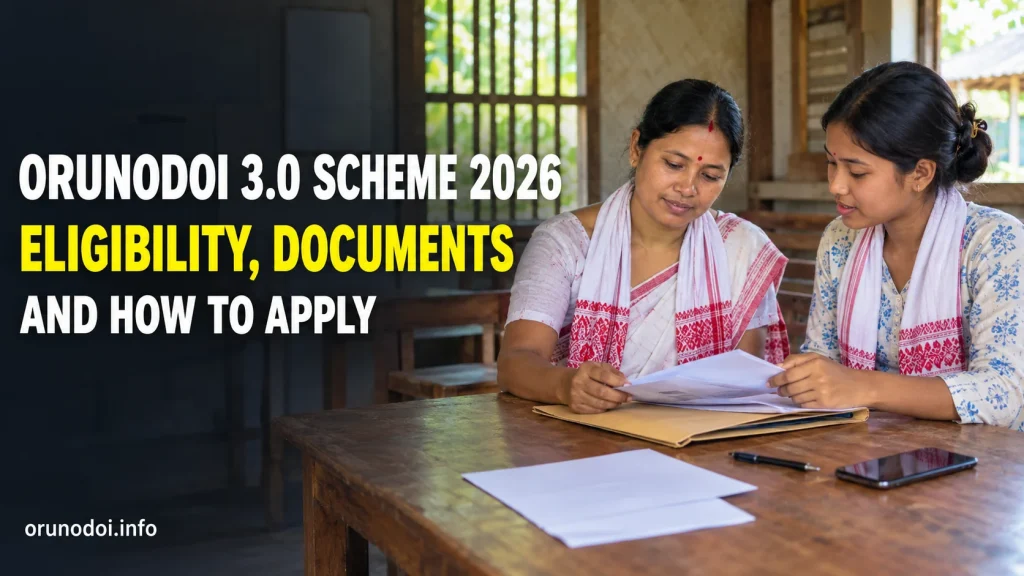
Exact requirements can vary slightly by district, so confirm with your local office. In general, keep these handy:
- Ration card that is Aadhaar-seeded
- Aadhaar card
- Bank passbook or account details of the beneficiary
- Supporting documents for any priority category you are claiming
- The undertaking-cum-checklist, which is filled in at the local level (one form per household)
How selection and application work
This is where many websites mislead people, so let’s be clear: Orunodoi is not a scheme where you simply fill an online form and wait. The first selection is done locally, at the Gaon Panchayat, Village Council Development Committee (VCDC) or Urban Local Body (ULB). A district-level committee then prepares the final list.
So in practice:
- Visit your Gaon Panchayat, VCDC or ward/municipal office and ask whether applications are open.
- Carry the documents listed above, with photocopies.
- Get the checklist filled and signed as the officials direct.
- Wait for verification. The officials check your eligibility, the Aadhaar-seeded ration card and your bank details.
- If you are selected, the money comes to your bank account by DBT.
[If you have visited an office or spoken to someone, add one or two lines of what actually happened. Only write this if it is true.]
Common problems to check before you apply
- Your ration card and Aadhaar are not linked.
- The bank account is inactive, or the name does not match your Aadhaar.
- The mobile number linked to the account is old or switched off.
Fix these first. It saves a lot of running around later. If you need help with the ration card side, see our guide on how to complete ration card e-KYC in Assam.
Beware of agents
There is no fee to apply or to be selected. If someone asks you for money to “put your name on the list”, walk away.
Check your status
Use the official portal at orunodoi.assam.gov.in or ask at your local office. We explain the list and status process in our beneficiary list guide.
Quick answers
Is there a single online form for the whole state?
No. Selection starts at the local level, as explained above.
Can I lose my benefit if I was in Orunodoi 2.0?
Eligible earlier beneficiaries are not supposed to be removed without reason, but the final decision rests with the authorities.
Who do I contact if my name is missing?
Start with your Gaon Panchayat or ward office, then the district administration.
Conclusion
Orunodoi 3.0 ek simple idea par chalta hai: zarooratmand parivaar ko har mahine seedha bank account mein madad. Dikkat tab aati hai jab log galat websites ya agents ke chakkar mein pad jaate hain. Yaad rakhne wali baatein kam hain. Selection local level par hota hai, documents mein ration card, Aadhaar aur bank details sabse zaroori hain, aur kisi ko paise dene ki zaroorat nahi hai.
Apne documents pehle se theek rakho, aur jaankari hamesha official page ya apne local office se confirm karo. Nayi update aane par hum yeh guide badal denge.
(Is paragraph ko apni bhasha mein English mein likho. Neeche final English version hai.)
Orunodoi 3.0 works on a simple idea: regular monthly support, paid straight into the bank account of a household that needs it. Most of the trouble starts when people rely on fake websites or agents. The key points are few. Selection happens locally. The ration card, Aadhaar and bank details matter most. And nobody should ever pay money to be selected.
Keep your documents in order, and always confirm the latest details on the official page or at your local office. We will update this guide when anything changes.
Frequently Asked Questions
What is Orunodoi 3.0?
Orunodoi 3.0 is the third phase of the Assam government’s monthly cash support scheme. Money is paid by Direct Benefit Transfer (DBT) to eligible households, usually to a woman of the house.
How much money does Orunodoi 3.0 give?
Eligible beneficiaries get ₹1,250 per month. [Verify on the official page and add the date you checked.]
Who is eligible for Orunodoi 3.0?
Eligibility is decided by household. The household should be in Assam, and its income should be within the limits of the Assam Food Security Rules under the NFSA. Some groups get priority. [Add the official priority list.]
Who is not eligible?
Households already receiving Orunodoi Plus, households getting the same or a higher cash benefit from a similar state scheme, and households with income above the NFSA limits.
Which documents do I need?
Keep an Aadhaar-seeded ration card, your Aadhaar card, bank account details and, if you claim a priority category, supporting documents ready. Requirements can differ slightly by district, so confirm with your local office.
Is there an online form to apply?
Selection starts at the local level (Gaon Panchayat, VCDC or Urban Local Body), and you apply when applications are invited. Check the official scheme page and your local office to see whether any application window is open.
Is there any fee to apply or to get selected?
No. The scheme is free. If anyone asks for money, do not pay.
I was in Orunodoi 2.0. Will I lose my benefit?
The guidelines say that earlier beneficiaries who are still eligible should not be removed without reason. The final decision, though, rests with the authorities.
My name is missing from the list. What should I do?
Go to your Gaon Panchayat or ward office first, then the district administration. Carry your documents with you.
Is Orunodoi.info an official website?
No. We are an independent information website. We do not accept applications or process payments. Read our disclaimer for details.