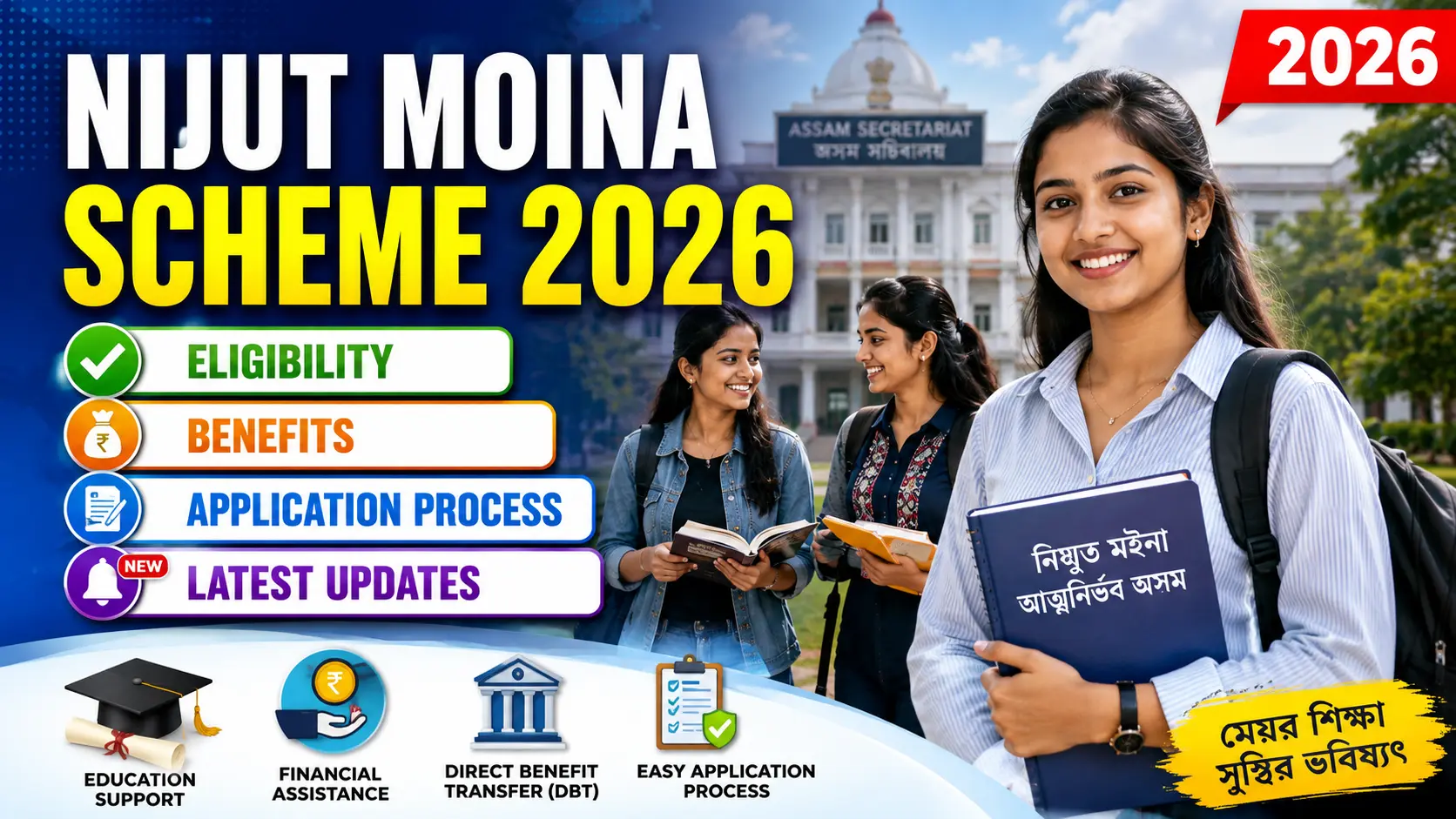
The Mukhya Mantri Nijut Moina Aasoni is a flagship scheme of the Assam government aimed at empowering young women through education and breaking the cycle of child marriage. Here is a complete guide to the scheme.
A Vision for a New Assam
In a significant step towards social reform, the Government of Assam launched the ambitious Mukhya Mantri Nijut Moina Aasoni (often simply called the Nijut Moina scheme) on August 8, 2024. The scheme is designed to provide a safety net for girl students, encouraging them to continue their higher education and become self-reliant.
The Assam Higher Education Department is the implementing body for this scheme, which falls under the broader vision of the state to improve its Gross Enrolment Ratio (GER) and align with the goals of the National Education Policy (NEP) 2020.
What Does “Nijut Moina” Mean?
The name Nijut Moina translates to “loving daughter” in Assamese. The title reflects the state’s nurturing approach towards its daughters, aiming to provide them with the same opportunities and care as one would within a family, regardless of their economic background.
The Twin Objectives: Education and Empowerment
The scheme was born out of a need to address two deeply interconnected challenges in Assam: low female enrolment in higher education and the prevalence of child marriage. Before the scheme, many families, especially in rural areas, were forced to marry off their daughters early due to financial constraints.
The government’s approach is simple yet powerful: Provide a monthly allowance for girls to stay in school and college, alleviating financial pressure on families and making education a more viable option.
Financial Support: A Breakdown of the Benefits
Under the scheme, eligible girl students receive a monthly allowance for up to 10 months in an academic year (excluding summer vacation months like June and July). The amount increases with the level of education.
Here is the current breakdown of the financial assistance :
- Higher Secondary (Class 11 & 12): Students receive Rs. 1,000 per month, amounting to Rs. 10,000 annually.
- Undergraduate (Graduation 1st & 2nd Year) & Integrated Teacher Education: Students receive Rs. 1,250 per month, amounting to Rs. 12,500 annually.
- Postgraduate & B.Ed. Students: Students receive Rs. 2,500 per month, amounting to Rs. 25,000 annually.
Note: The payment is made via Direct Benefit Transfer (DBT), ensuring the money is credited directly to the student’s bank account.
Expansion to Polytechnic and ITI Students
The government has further expanded the scheme’s reach to include girls in polytechnic institutes and ITIs, ensuring that vocational and technical education is also encouraged.
Who is Eligible?
The scheme is designed to be universal for Assamese girls to ensure maximum coverage. The eligibility criteria are fairly straightforward:
- Domicile: The student must be a resident of Assam.
- Institution Type: She must be enrolled in a government or venture educational institution (which includes provincialised colleges and universities). Private colleges and universities are not covered.
- Course: The student must be in the first or second year of Higher Secondary, Undergraduate, Postgraduate, or B.Ed.
- Marital Status: Unmarried students are primarily eligible. However, married students pursuing Postgraduate (PG) or B.Ed. courses are an exception and are allowed to continue receiving the benefits.
Who is Not Eligible?
To prevent duplication of benefits and ensure the scheme reaches its intended audience, certain categories are excluded :
- Daughters of Ministers, Members of Parliament (MPs), or Members of the Legislative Assembly (MLAs).
- Students who are already receiving benefits under other specific government schemes, such as the Jibon Prerana Scheme (for PG students) or the Banikanta Kakati Award (Scooter Scheme).
- In-service government employees who are pursuing B.Ed. on deputation.
How to Apply
The application process for the Nijut Moina scheme is primarily institution-based, making it accessible for students :
- Collect the Form: Eligible students need to collect the prescribed application form from the Nodal Officer (usually a designated teacher) at their respective schools, colleges, or universities.
- Submit the Form: Fill out the form accurately, attach the required documents (such as Aadhaar card, bank account details, and previous academic mark sheets), and submit it back to the institution.
- Institutional Verification: The institution verifies the documents and forwards the application to the Higher Education Department for final approval.
- No Re-application: For the second year of the same course, students do not need to re-apply. The institution’s head will provide a certificate of continuity, ensuring the support continues seamlessly.
The Impact: Changing Lives and Numbers
The Nijut Moina scheme has rapidly shown its impact on the ground.
- Curbing Child Marriage: Chief Minister Himanta Biswa Sarma has credited the scheme alongside strict enforcement actions (with thousands of arrests related to child marriage) for changing the mindset of parents. Families now see the economic and social value in keeping their daughters in school rather than marrying them off early.
- Rising Enrollment: The Gross Enrolment Ratio (GER) in the state has seen a marked improvement. Reports suggest a significant reduction in dropout rates at the higher secondary level.
- Growing Reach: The scheme is seeing a massive year-on-year expansion. While it benefited around 1.6 lakh students in its first phase, the 2025-26 edition is targeting to cover over 4 lakh girl students. The ultimate goal is to support 10 lakh girls.
The Future: Nijut Moina 2.0 and Beyond
The success of the scheme has led to the launch of “Nijut Moina 2.0,” which broadened its scope. It now includes girl students in central universities, self-financed courses, and polytechnics.
Furthermore, the government has introduced the “Nijut Babu” scheme, a parallel initiative designed to support economically weaker male students pursuing undergraduate and postgraduate studies, ensuring that the wave of educational upliftment is gender-inclusive.
Conclusion
The Mukhya Mantri Nijut Moina Aasoni is more than just a scholarship; it is a social revolution. By tackling the financial hurdles that often cut a girl’s education short, the Assam government is building a future where young women are not just mothers and homemakers, but also doctors, engineers, teachers, and leaders. It stands as a powerful example of how direct financial support can rewrite the destiny of millions, creating a safer, smarter, and more equitable society for all.

Helping people with simple and reliable information about the Orunodoi Scheme, Assam Government welfare schemes, and public services.